
 ID
ID  EN
EN 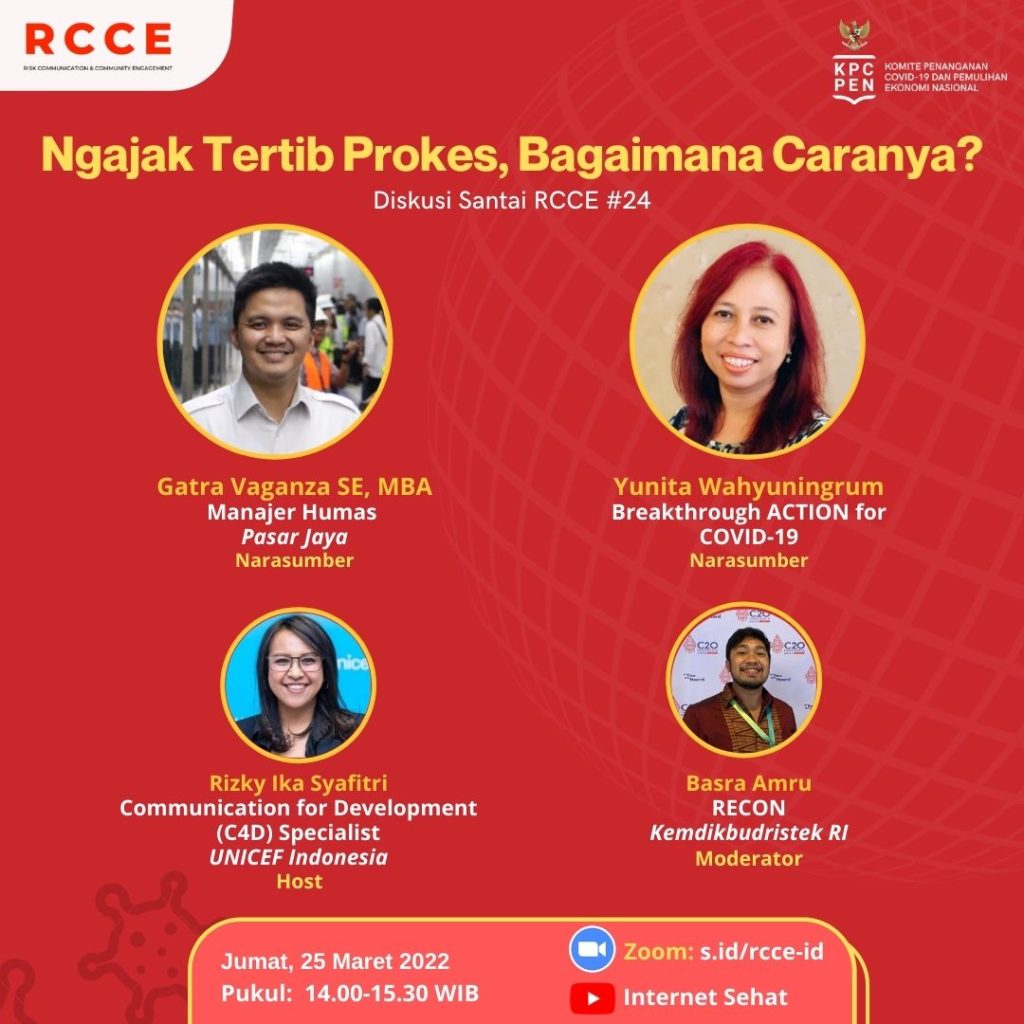
Currently, people all around the world are already buzzing about the transition from a pandemic to an endemic state. During the concurrent transition of the COVID-19 pandemic to being endemic, people are becoming more and more careless about obeying the regular health protocol. Whilst, the main key to in the transition era, is how people can still comply with health protocols and completed the vaccines to pass through pandemic to endemic stage. The 24 RCCE discussion on 25th March 2022,
presenting speakers from practitioners and researchers that linked between the assessment result, recommendation in
adjusting the public health policy and communicating the policy in the daily life implementation.
Gatra Vaganza SE, MBA, PR Manager of Pasar Jaya stated that “In the past, the COVID-19 situation was life-threatening. Now, it isn’t. So, it reduces the public’s alertness, which happens to the merchants in traditional markets.” – Gatra Vaganza S.E., MBA.
Yunita Wahyuningrum, from Breakthrough ACTION (BA) for COVID-19 team, presented various kinds of data from a survey presented in COVID Behaviour Dashboard (covidbehaviors.org) conducted by Johns Hopkins Center for Communication Program and qualitative assessment of vaccine hesitancy among unvaccinated people. The survey result showed that the trend data reported up to March 1-15, 2022, the social norm of vaccination increased, 89% of people believe all or most of the people are vaccinated and it was found that social norm of wearing mask decreased, 68% people believe all or most of the people wear mask. Regarding to COVID-19 testing data in January 2022, the top reason for testing were travel requirement (34%) and employer or school requirement (29%). Only 5% said that they tested because that felt sick.
From qualitative assessment for understanding the vaccine hesitancy, it was found that concern of side effect, doubtful of vaccine works, do not see the benefit of vaccine and afraid getting vaccination due to comorbid are the most frequent reasons
reported Many female adults reported not getting vaccines due to their husbands prohibiting them, breastfeeding, or having an
underlying disease. While male adults are mostly uncertain about the vaccines’ benefit and concern with the side effects. Many
elderlies are uncertain about the vaccines and are afraid of the side effects that could emerge. Those with underlying diseases are already certain that they can’t be vaccinated without consulting professionals beforehand. Some think that vaccines are meant for young and healthy people. “I don’t want to be vaccinated because I’m old, let the children have it because they’re still young. My friends don’t want to be vaccinated as well because they are old.” Overall, people are uncertain because they think that the vaccines would make them sick and knew that people still get infected of COVID-19 even though they have been vaccinated.
In rural areas, people have trouble getting vaccines due to their inaccessibility to reach the nearest public health center whether by long-distance or lack of transportation. For example, in Malaka Regency, a woman reported that it takes 10 km to reach her nearest health center and there is a long queue when she arrived.
Yunita highlighted that all this time, the people’s understanding of vaccination is to prevent them from contracting the virus. What should have been educated is that vaccination is able to reduce the severity of the symptoms and mortality rate. In addition, it must be emphasized that the drastic drop in the death rate is due to vaccinations. Another message that must be conveyed is that people with comorbid diseases can still be vaccinated as long as they are under controlled conditions according to medical prescriptions or consultations.
“to fix this, the government’s policy and the message associated with it must be refreshed before it is spread anew to the public”
Dian Rosdiana - BA Communication Team Leader
