
 ID
 EN
Five cities took part in an initial exploration process, and two have moved forward to implementation. Through The Challenge Initiative, Kemendukbangga/BKKBN and Yayasan Jalin Komunikasi Indonesia are promoting an approach that places local governments at the forefront of strengthening Family Planning and Reproductive Health programs.
Sustainable Family Planning and Reproductive Health (FP/RH) programs require more than effective interventions. They also depend on strong local leadership, the ability to use data for decision-making, resources that can be optimized, and cross-sector collaboration to address the diverse needs of communities across different regions.
These principles underpin the implementation of The Challenge Initiative (TCI) in Indonesia.
Kemendukbangga/BKKBN and Yayasan Jalin Komunikasi Indonesia introduced TCI to city governments as an approach to strengthen local capacity to manage FP/RH programs. In its implementation, Yayasan Jalin Komunikasi Indonesia serves as the TCI Hub in Indonesia, working with local governments and various stakeholders under the coordination of Kemendukbangga/BKKBN.
Unlike approaches that introduce a predetermined package of activities, TCI is demand-driven. Local governments are positioned as the primary actors in identifying challenges, setting priorities, selecting and adapting evidence-based interventions, and optimizing available resources.
Through its Business Unusual approach, TCI provides support through coaching and capacity strengthening. The goal is not to establish new systems that operate in parallel with government structures, but to strengthen existing systems so that local governments are increasingly able to lead, manage, and sustain program improvements independently.
Five Cities Begin the Journey
TCI Indonesia’s initial journey began in April 2026 through a series of meetings and discussions with five city governments: Bogor, Tangerang, North Jakarta Administrative City, Surabaya, and Depok.
The consultations began in Bogor on April 27, 2026, followed by Tangerang on April 28, North Jakarta and Surabaya on April 30, and Depok on May 7, 2026.
These meetings were more than opportunities to introduce TCI. Dialogues with city leaders, government agencies, and relevant stakeholders also provided an opportunity to understand the different FP/RH challenges faced by each city—from strengthening data and postpartum family planning services to building human resource capacity, improving access and quality of care, and strengthening public trust in family planning.
This is where one of TCI’s key principles began to take shape: there is no one-size-fits-all solution for every city.
Following the consultations, the city governments continued the process through an Expression of Interest (EOI). The EOI assessed each city’s level of commitment, needs, and readiness across several areas, including local leadership, system readiness, policy and resource support, potential impact, and cross-sector collaboration.
The EOI also marked an early step toward building the principle of co-investment. City governments were encouraged to identify and optimize existing resources and financing to support priority interventions. In this way, ownership and sustainability were built into the program from the outset, rather than after external support ends.
Surabaya and Depok Move to the Next Stage
Following the assessment process, Surabaya and Depok were selected on June 2, 2026, as the first two cities to move forward with TCI implementation in Indonesia.
However, becoming a TCI partner city did not mean that the same set of activities would immediately be introduced in both cities.
Instead, the next stage began by developing a deeper understanding of each city’s context.
Through Landscape Analysis, the city governments and TCI Jalin Indonesia explored the state of FP/RH programs, service delivery capacity, implementation gaps, and opportunities to strengthen existing systems. These findings then informed the joint program design process.
The process continued through Collaborative Program Co-Design Workshops, held in Surabaya on June 17–19, 2026, and in Depok on June 23–25, 2026.
During the workshops, local governments and stakeholders were not simply asked to provide input on a pre-designed program. Together, they identified gaps, analyzed root causes, established priorities, and selected the High Impact Interventions (HII) and High Impact Practices (HIP) most relevant to each city’s needs.
The results demonstrated how the same approach can lead to different priorities in different contexts.
In Surabaya, three strategic areas emerged as priorities: strengthening family planning and postpartum family planning (KBPP) services, increasing community demand for family planning services, and strengthening advocacy, policy, and financing support for program sustainability.
In Depok, priorities included strengthening provider capacity and the quality of family planning services, increasing community awareness and trust in family planning, and strengthening the enabling environment through governance, data use, and cross-sector coordination.
The program design, therefore, was based not only on what has been proven effective elsewhere, but also on what each city genuinely needs and has the capacity to implement.
From Design to Capacity to Lead
A well-designed program requires people who can effectively support the change process.
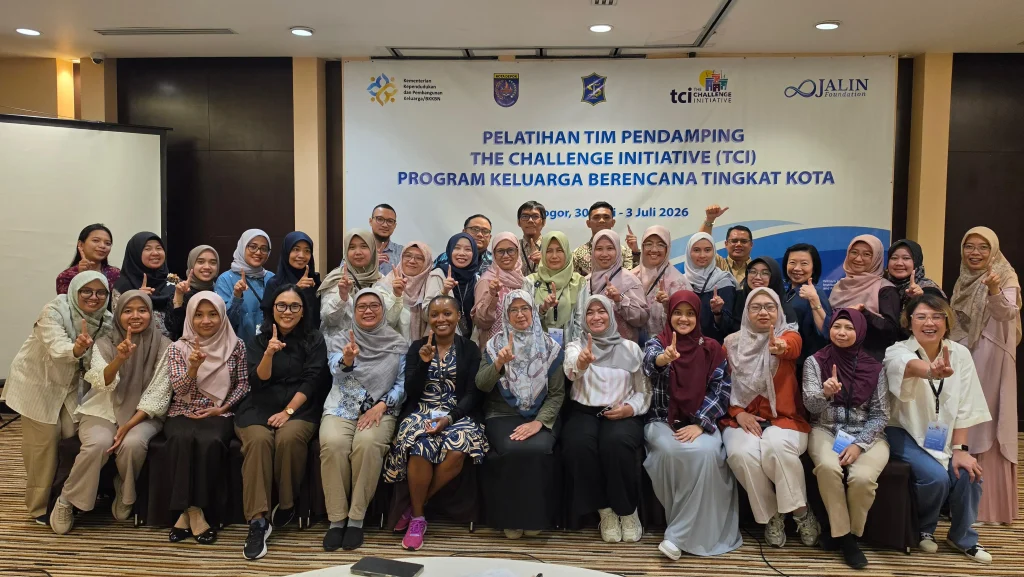
Following the co-design process, TCI Jalin Indonesia and Kemendukbangga/BKKBN conducted a Master Training of Trainers (MTOT) from June 30 to July 3, 2026, in Bogor to prepare Master Coaches who would support the city governments.
Participants strengthened their skills in using data for decision-making, accessing TCI’s evidence-based learning resources and interventions, and applying coaching and facilitation techniques.
Coaching is a key element of the TCI model. Coaches do not take over the work of local governments. Instead, they help city teams identify challenges, develop solutions, build confidence, and gradually strengthen their ability to implement programs independently.
This principle is reflected in the Lead–Assist–Observe approach. Initially, TCI provides more intensive support. Over time, local governments take on a greater role, until city teams are able to lead and scale strengthened practices with increasingly limited TCI support.
Local Governments as Owners of Change
As they enter the next phase, Surabaya and Depok are moving from planning toward implementation. Program designs, indicators, workplans, stakeholder roles, and coaching mechanisms continue to be refined together to translate shared priorities into action at the city level.
The journey—from five cities participating in the initial consultations to the selection of Surabaya and Depok—shows that TCI is not simply about introducing new interventions. It is about building the capacity of local governments to set priorities, use data, adapt evidence-based practices, mobilize resources, and lead change within their own systems.
For TCI, success is ultimately not measured by how long a program supports a city, but by how well local governments can continue, expand, and sustain improvements as the intensity of external support decreases.
Through the partnership between Kemendukbangga/BKKBN, Yayasan Jalin Komunikasi Indonesia, local governments, and diverse stakeholders, TCI’s early journey in Indonesia is now entering its next chapter: turning the commitments and designs developed together into practical action that can sustainably strengthen Family Planning and Reproductive Health programs.
