
 EN
 ID
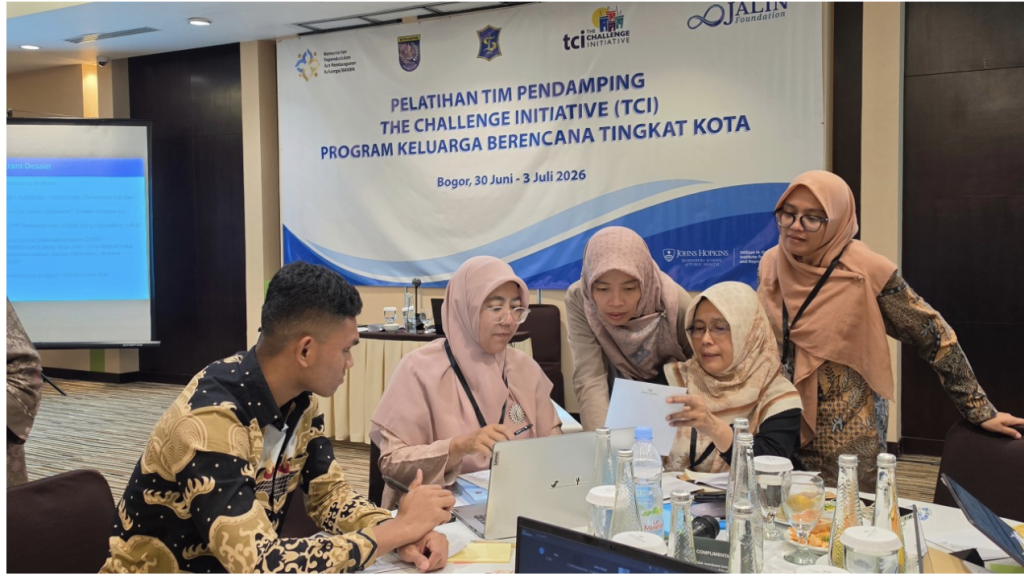
Sustainable public health programs are not built by projects alone—they are built by people who can lead change, coach others, and strengthen systems from within.
This principle was at the heart of the Master Training of Trainers (MTOT) organized by TCI Jalin Indonesia in collaboration with Kemendukbangga BkkbN from 30 June to 3 July 2026 in Bogor. The training marked an important milestone as Indonesia prepares to implement The Challenge Initiative model in its first partner cities, Surabaya and Depok.
The training was officially opened by dr. Ruri Mutia Ichwan, MKM, Director of Reproductive Health at Kemendukbangga/BKKBN, who joined virtually to reaffirm the Ministry’s commitment to strengthening Family Planning and Reproductive Health (FP/RH) programs through stronger local leadership and sustainable capacity development.
Rather than focusing solely on technical knowledge, the four-day training was designed to prepare Indonesia’s first cohort of Master Coaches—technical leaders who will mentor and accompany local governments in designing, implementing, and sustaining evidence-based FP/RH programs.
The workshop brought together 44 participants representing Kemendukbangga/BKKBN, the Ministry of Health Kementerian Kesehatan , the Ministry of Home Affairs Kementerian Dalam Negeri , provincial BKKBN offices, City Leadership Teams, and TCI Jalin Indonesia. Throughout the training, participants strengthened not only their technical competencies but also their coaching, facilitation, and leadership skills—recognizing that lasting change happens when local governments are empowered to lead their own solutions.
One of the greatest strengths of this training was the opportunity to learn directly from countries that have already completed the TCI journey.
We were honored to welcome Dr Njeri Nyamu , Chief of Party of TCI East Africa, in person, and Hitesh Sahni, Chief of Party of TCI India, through online, who shared nearly a decade of experience leading TCI implementation since 2017. Through their presentations and interactive discussions, participants gained valuable insights into how India and East Africa successfully strengthened government ownership, institutionalized coaching systems, scaled evidence-based interventions, and ultimately reached TCI Graduation—a milestone demonstrating that local governments have developed the capacity to sustain and expand improvements independently.
The learning experience was further enriched by TCI Jalin Indonesia’s own technical team. Sessions and practical exercises were facilitated by Juhartini Juhartini , Program Manager of Jalin Foundation; Ita Rahma , Chief of Party of TCI Jalin Indonesia; and akhir riyanti , MLE Lead of TCI Jalin Indonesia. Together, they guided participants in adapting global TCI approaches to Indonesia’s policy environment, local governance structure, and implementation context while facilitating coaching simulation, program design exercises, and action planning for the first partner cities.
The exchange between global and Indonesian facilitators reinforced an important lesson: sustainable impact is achieved not by introducing new programs, but by strengthening existing government systems, investing in local leadership, and enabling data-informed decision-making.
Throughout the four-day program, participants explored the full TCI implementation framework—from understanding the Business Unusual approach and navigating TCI University, to conducting gap analysis, designing city-specific interventions, strengthening postpartum family planning services, generating community demand, integrating supply and demand strategies, and developing coaching structures and implementation roadmaps tailored to Indonesia’s context. Practical simulations, group exercises, and peer learning ensured that participants left with actionable plans rather than theoretical knowledge alone.
Key takeaways from the MTOT
• Coaching is a catalyst for systems change. Effective mentors do more than transfer knowledge—they facilitate problem-solving, build confidence, and help local governments make evidence-based decisions.
• Government ownership is essential for sustainability. TCI’s “Business Unusual” approach places local governments at the center of planning, implementation, financing, and continuous improvement.
• Data should guide every decision. Participants strengthened their ability to use routine data, identify implementation gaps, prioritize interventions, and monitor progress throughout the program cycle.
• There is no one-size-fits-all solution. Although Surabaya and Depok share the same overall goal of strengthening Family Planning and Reproductive Health programs, each city requires interventions tailored to its own priorities, challenges, and resources.
• South-South learning accelerates innovation. Learning directly from India and East Africa demonstrated how proven approaches can be adapted—not copied—to Indonesia’s unique context.
As TCI Indonesia moves into implementation, these Master Coaches will become the bridge between national policy and local action. They will accompany city governments in translating evidence into practice, strengthening local capacity, and fostering a culture of continuous learning and improvement.
The Challenge Initiative (TCI), led globally by the Gates Institute at the Johns Hopkins Bloomberg School of Public Health , has supported city governments across Africa and Asia since 2017 to expand access to high-quality Family Planning and Reproductive Health (FP/RH) services through a city-led, evidence-based, and sustainable approach. By investing in local leadership and government ownership, TCI has helped cities strengthen health systems and continue improving FP/RH outcomes well beyond the period of direct program support.
The implementation of TCI in Indonesia is made possible through funding support from Bayer , whose investment enables the adaptation of this proven global model to the Indonesian context. Through the collaboration of Kemendukbangga/BKKBN, Jalin Foundation, local governments, and TCI’s global network, Indonesia is now part of a growing community of countries committed to strengthening Family Planning and Reproductive Health through locally led solutions, knowledge exchange, and sustainable systems change.
This Master Training of Trainers marks more than the completion of a workshop—it is the beginning of a long-term journey to build local capacity, strengthen institutions, and empower cities to lead lasting improvements in Family Planning and Reproductive Health for the communities they serve.
